
If you are a business leader or team manager, like me, you are probably exhausted by the relentless volume of AI hype. New AI technology releases and updates to existing platforms can make last week’s version feel outdated overnight. It is easy to feel behind, as if you are missing a critical window of transformation. However, true operational freedom does not come from chasing technical flash; it comes from achieving better business outcomes through strategic clarity.
How do we shift our reliance on “shiny new tools” and move toward an outcome-first mindset? It begins by changing the question. Instead of asking, “What can this AI tool do?”, we need to know, “What business problem are we solving?” This becomes a critical question as we leap into the age of Agentic AI: systems that do not just provide information but actively execute work.

Because of the nature of modern AI, tools like Claude Code, Replit Agent, Cursor, and Lovable allow for rapid “vibe coding” where software is built through natural language, meaning that almost anyone can now deploy functional code, whether those systems are successful and secure or not. This low barrier to entry is exactly why we need a structured framework. To move from manual drag to operational freedom without risking your reputation, you need what I call Business Insurance for the AI Age.
To protect your bottom line, your strategy must rest on three non-negotiable pillars. First, Planning avoids the “Master of None” trap by architecting integration as infrastructure, connecting specialised, best-in-class tools to ensure your business remains agile. Second, Governance provides the guardrails that enable speed, preventing the risks of unauthorised “Shadow AI” while ensuring every automated action yields a clear, explainable return. Finally, Ethics defines your human interaction model: deciding whether AI acts as a “Co-pilot” to augment your staff or an autonomous “Auto-pilot” that executes end-to-end processes.

The “Silent Failure” Warning
Most AI projects in SMEs do not end in a spectacular crash. They suffer from “Silent Failure.” This occurs when a pilot is “technically functional” but fails to move the needle on revenue, customer experience, or staff morale.
If an implementation does not solve a real business problem, it is a drain on resources and a waste of money. It erodes staff confidence and leaves the organization no more competitive than when it started. A tool that “works” but leaves your manual drag intact is a business failure.
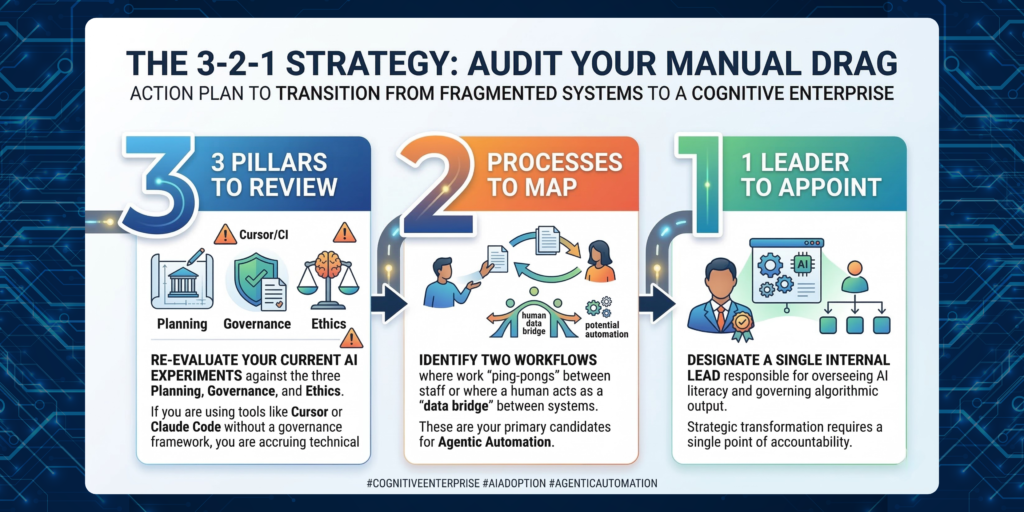
The 3-2-1 Strategy
To transition from fragmented systems to a cognitive enterprise, you must first re-evaluate your current AI experiments against the three strategic pillars of Planning, Governance, and Ethics. If your team is already using powerful tools such as Cursor or Claude Code without a formal governance framework in place, you are likely accruing significant technical debt that will eventually stall your progress.
The next step is to identify and map specific workflows where work currently “ping-pongs” between staff or where a human is acting as a literal “data bridge” to move information between systems. These areas of manual drag are your primary candidates for Agentic Automation and represent the highest immediate return on your investment.
Finally, you should designate a single internal lead who is responsible for overseeing AI literacy and governing algorithmic output. Strategic transformation cannot happen in a vacuum; it requires a single point of accountability to ensure that your automation efforts remain aligned with your broader business objectives.
Understand Strategy to Execution
If you are ready to move beyond the theory please reach out to us for a friendly, informal chat.